
Most deals you're shown in December won't be placed in service until 2027.
This one was placed in service on August 28. I had a two-page summary written for you and for your accountant, because the tax question gets settled in their office and the rest of it you can judge yourself.
I took a $1.5 million projected tax bill to zero with cost segregation on two commercial buildings I owned, one in Baker City, Oregon and one in Idaho Falls. That worked because of how I'm structured, and yours depends on your situation. That's your CPA's call, which is why the summary is written for them.

I'm Brent Neely. I buy apartment buildings in Boise and run them to a written plan, with my own money in every deal beside my investors'. The rest of the story is on the deal page, where it belongs.
The summary is free, whoever you are
Your name, email and a phone number if you want me to be able to call. Two pages of facts and arithmetic, in your inbox in a few minutes.
Then three quick questions
About thirty seconds, so I know what's actually useful to send you next instead of emailing everybody the same thing.
Investing is a separate bar
It's a Rule 506(c) offering with a $50,000 minimum, so an actual investment is verified accredited investors only. Reading the document isn't.
Get the CPA summary
The entities, the basis, the placed-in-service date, the projected first-year deduction and the arithmetic under it. Written so you can forward the whole thing to your accountant without editing it first.
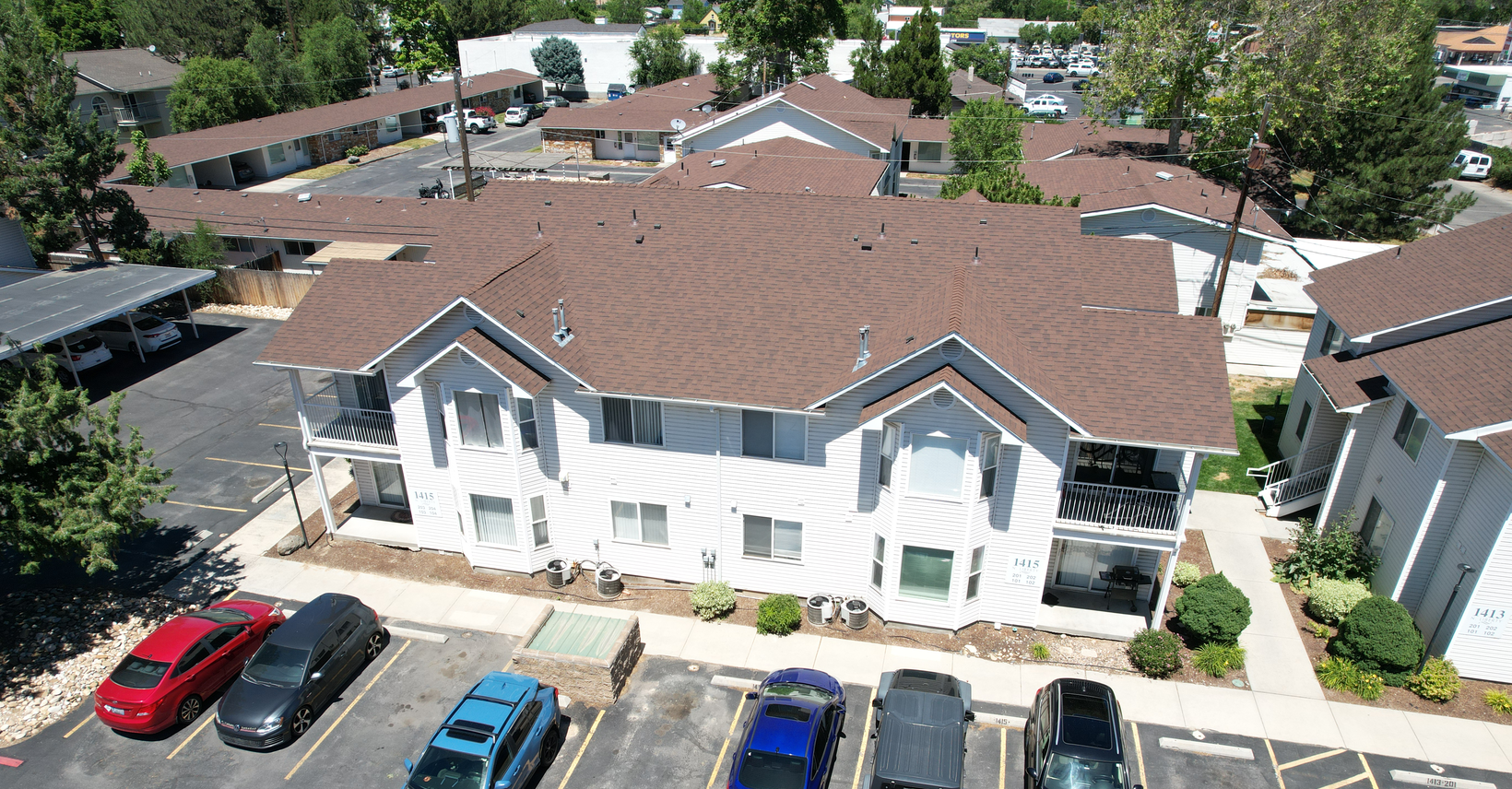
Placed in service August 28, 2026
A property has to be in service during the tax year to produce a deduction for that year. Most of what's being marketed right now hasn't closed. If it goes into service in 2027, the deduction is a 2027 deduction, whatever the deck says.
Aspen closed and went into service on August 28, 2026. It has had tenants, rent collections and renewals since. Money that funds in December still lands in the 2026 allocation.
None of that is tax advice, and I'm not qualified to give you any. Your accountant decides what it does on your return. That's the whole reason the document is written for them.
The Fund allocates. Your CPA applies. The figures are the Fund's projected depreciation allocation, reported to each investor on a Schedule K-1. Whether you can use it in 2026, against what income, and how your state treats it are questions for your CPA.
Name, email, then three quick questions. About a minute.
A deduction is not a reason to buy a building
If the tax piece were the only thing here I wouldn't have bought it, and I wouldn't have put my own money in it. There are four ways a deal like this makes money. The deduction is one of them, and it's the only one with a December 31 deadline attached.
- 01Appreciation, when the plan works20.2% targeted IRR · 2.36x targeted equity multiple
Net to investors, over a targeted five-year hold. The rents in place were below market when I bought it, so the plan is renovating units on natural turns and closing that gap, not betting the market reprices. The model carries 3.5% rent growth for the whole hold, just above the 3.1% Boise apartments actually collected last year and nowhere near the asking rents people quote.
- 02Cash flow, paid monthly7.5% targeted average annual cash-on-cash · 8% preferred return
Distributions are monthly and scheduled to begin November 1, 2026. The first 8% a year accrues to you before I participate at all, and above it the split is 70/30 in your favor with no catch-up for me.
- 03Principal paydown, which I gave up on purpose$6,535,000 fixed at 6.24%, interest-only for all 60 months
On an amortizing loan, part of every payment buys down principal, and this is the part most people miss: the return you earn on those dollars is the interest rate, and nothing more. Here that's 6.24%. It's the lowest return available anywhere in this deal, and the money comes straight out of what would otherwise be distributed to you.
So I took interest-only for the full term on purpose. Those dollars stay in the deal earning the deal's return instead of the lender's rate, which raises the monthly distribution and the targeted return over the five-year hold. The tradeoff is real and you should know I made it: the loan balance at sale is the same balance I borrowed, so none of the return comes from quietly paying down debt. It has to come from operations and the exit.
- 04Depreciation, which is why you're hereProjected 88.7% of invested capital in year one
On $100,000, a projected first-year deduction of $88,719, about $0.89 per dollar, allocated to you on a Schedule K-1. That's from the engineering cost segregation study, completed October 2026, assuming 100% bonus depreciation. What it does on your return is your CPA's call, not mine.
Every return figure above is net to you. The 20.2% IRR, the 2.36x multiple and the 7.5% average cash-on-cash are all shown after every fee I'm paid and after my share of the profit. None of them is a gross or pre-promote number. Targeted and projected from the locked underwriting model, August 26, 2026 cut, not guaranteed. A projection is the least reliable number on this page.
What I earn, and it comes out before those numbers, not after: a 2% acquisition fee paid at closing, 2% of collected income while I run it, 1% at sale, and a $31,725 fee for personally signing the loan. Then 30% of the profit, but only after you've received your capital back and an 8% annual preferred return on it. If a fee only looks reasonable once you've seen the upside, it isn't reasonable. They're itemized on the deal page.
What all four of those are worth on your money
Move the slider. The deduction, the monthly income, and the payout at sale are all projections off the same locked model the figures above come from, scaled to whatever you'd actually place.
A first-year paper loss reported on your Schedule K-1, not cash. From the engineering cost segregation study, completed October 2026, assuming 100% bonus depreciation. What it does on your return is your CPA's call.
Paid monthly, starting November 1, 2026. It climbs because renovated units reach market rent on natural turns, not because rents are assumed to spike. The five-year average of these is the 7.5% cash-on-cash quoted above.
Which is the 2.36x equity multiple and the 20.2% IRR on this page, net to you, after every fee and after my share of the profit. The sale is the least certain line here: it rests on an exit assumption five years out, and a building is worth what someone pays for it on the day.
Every figure here is a projection from the locked underwriting model, August 26, 2026 cut, scaled to the amount you chose. Distributions are pro rata to capital, so the arithmetic is exact, but the underlying projections rest on assumptions that may not prove correct and none of it is guaranteed. The depreciation figure comes from the final cost segregation study. This is not tax advice and it is not an offer; any offering is made only through the Fund's documents to verified accredited investors.
The summary is where your accountant checks the depreciation half of this.
The deal, line by line
What has actually happened since takeover: three residents renewed at the rents I underwrote, which captured $450 a month of a $2,460 monthly gap between in-place and market rents, and September's net operating income came in ahead of the month-one plan. That is three leases and one month. It is not a trend, and I'm not going to extrapolate it for you.
Boise is the reason the plan is boring
Cushman & Wakefield Boise MarketBeat Multifamily, Q2 2026. The national rent figure is CBRE's Q2 2026 US number, a different publisher.
Zumper, September 2026 +15.9%+0.5%
Zumper, September 2026 +11.5%+0.1%
Cushman & Wakefield, Q2 2026 +3.1%+0.5%
Both are right and they count different things. Zumper measures what landlords are asking on units listed today, including single-family houses and condos, which is the market a renter is actually shopping. Cushman measures what stabilized apartment portfolios collected across every lease, most of them signed last year and not yet moved. Asking rents turn first. In-place rents follow slowly, and the spread between the two is roughly the opportunity this deal buys.
I underwrote to the slow number. The model carries 3.5% rent growth for the whole hold, just above Cushman's 3.1% and nowhere near the asking figure. Where this building actually landed: the three renewals signed so far came in between 9.7% and 12.8%, nearer the asking number than the institutional one. That's three leases, not a trend, and it's capture on rents that were below market to begin with rather than the market repricing.
Micron is investing roughly $50 billion in Idaho across two fabs, supporting about 17,000 jobs including roughly 3,500 permanent hires and 6,000 construction jobs, and announced another $10 billion research campus in Boise in August. Those people need somewhere to live. Meanwhile almost nothing is being built.
Supply 2026 to 2028: HelloData development pipeline, Boise city. Supply 2029 to 2030: NPI projection, assuming new starts can't pencil until late 2027 at the earliest and then take two to three years to deliver. Demand: NPI estimate, MSA population growth of 2.2% at roughly a 30% city share, 2.4 people per household, 50% renters, about 1,165 units a year, plus roughly 680 a year of Micron ramp. Range 1,500 to 2,000; the line is the midpoint.
The red band sits above the bars in every single year. That gap is the whole argument: more households forming than apartments being built, for as long as anyone can see. It's also why I underwrote 3.5% rent growth instead of something heroic. The shortage doesn't have to get worse for this plan to work.
I'm not asking you to believe in Boise. I'm pointing out that the deal doesn't need you to. Everything in the plan comes from renovating units and closing the gap on leases already below market. If the market does what the chart suggests, that's upside this plan doesn't depend on.
I funded $1,058,000 of this myself to close on time.
Partway through escrow my financing came apart. My earnest money was already hard and the seller had a date, so I took the debt back out to the market, worked it lender by lender, bought an extension, and closed on a fixed-rate non-recourse loan with better terms than the one that died. Then I wrote the check for the balance of the investor equity out of my own account so the deal closed fully funded, with no gap.
So what's available now is equity that was authorized at closing and never issued, on the same terms as the people who funded in August, and subscribing to it returns the capital I bridged. You'd be buying in at the price I paid, beside me, into a building that has been collecting rent since August 28. You learn more about a sponsor from the week his financing broke than from any deck.
Or read the full deal page, with the fees, the documents and the monthly updates.
December 31, and there is only so much of it
Money has to be funded by December 31, 2026 to land in the 2026 allocation. That's a tax-return date, not a sales device. It isn't a date I chose and I can't move it. After it, 2026 is closed and everything else is a 2027 conversation.
The other limit is simple arithmetic. This round is $1,379,986 and the minimum is $50,000, so it holds somewhere between a handful of investors and twenty-seven of them. It's allocated in the order people subscribe, and when it's allocated it's done. I'd rather tell you the size than imply it's bigger than it is.
Practically: accreditation verification, the documents and a wire all take time, so starting this in the last week of December is starting too late.
What's in the CPA summary
- Page one is for your accountant
The purchase price and the preliminary land allocation, the depreciable basis, the placed-in-service date, the reclassified buckets with their recovery periods, and the projected first-year deduction carried to the decimal.
- Page two is the deal in ten lines
Price, appraised value, the debt and its rate and term, what this round raises, the minimum subscription, the preferred return, the split, when distributions start, the hold period, and the K-1 delivery target.
- And what isn't settled yet
The cost segregation study is final. The projected first-year deduction is 88.7% of invested capital, about $0.89 per dollar. The summary shows the land allocation, the bucket allocation and the arithmetic carried to the decimal, and a table of the projected deduction at $50,000, $100,000, $250,000 and $500,000. Every forward-looking figure is labeled projected or targeted. None of them is guaranteed.
You'll get the study too, whatever it says
When the final cost segregation study is delivered, everyone who asked for the CPA summary gets the real thing with my notes on it, including where the projection was wrong and what the land allocation did to it. That's decided now rather than when the PDF shows up, because a number you only share when it's flattering isn't worth sharing.
This isn't for most people, and that's fine.
It's a Rule 506(c) offering with a $50,000 minimum, it's illiquid, and you could lose money. Don't do it with cash you need back inside a year or two. And if a deduction is the only reason you're here, take the document to your CPA before you come back to me. How much of it you can actually use comes down to how you're set up, and that's their call to make, not mine. If you're raising capital for your own deals, this isn't your document either.
Still reading?
Then it's probably worth the thirty seconds.
Or schedule a call instead, or read the deal page.